How Vertical Solar Can Reduce Land-Use Pressure
Lumiton Solar had mainly focused on vertical solar systems because land-efficient clean energy is becoming more important. The goal is to make solar deployment practical in more places, including sites that are too narrow, too remote or too complex for conventional PV layouts.
Lumiton Solar
7/22/20263 min read
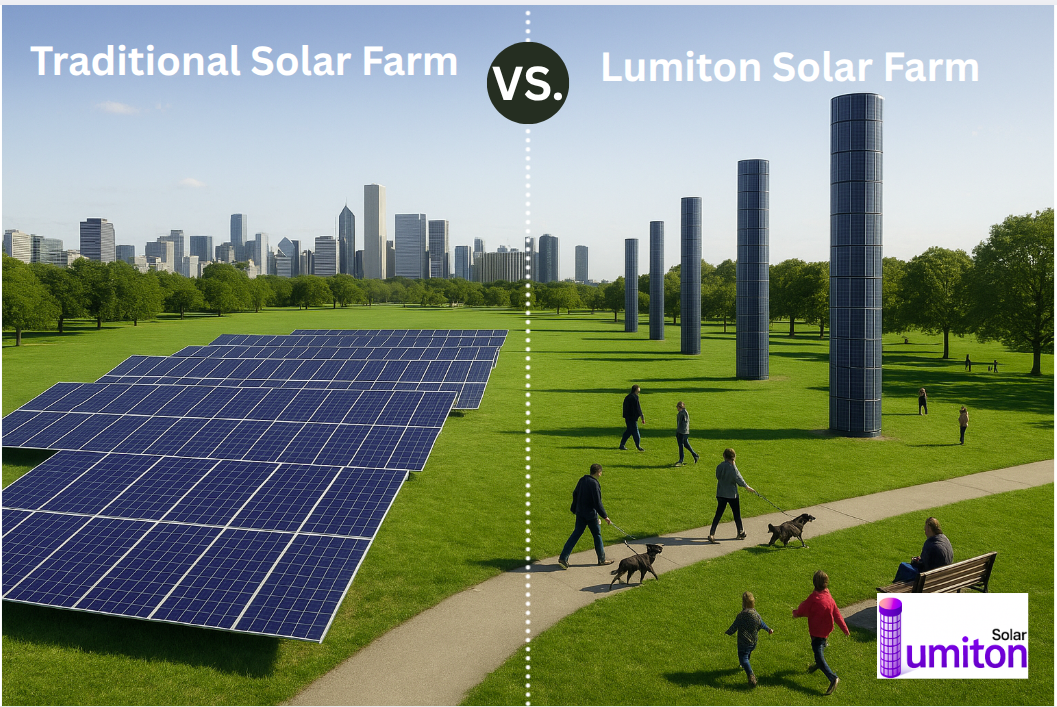
Traditional solar farms require large horizontal space, but Lumiton Solar will use vertical space to generate clean energy closer to homes, roads, facilities, and public infrastructure.
Which One You Choose?
Solar energy needs space. Conventional solar farms use large areas of land, while rooftop solar depends on suitable roofs. As solar deployment grows, land-use pressure becomes a serious planning issue. Communities need clean energy, but they also need farmland, housing, biodiversity, transport corridors and public space.
Vertical solar can help by changing the shape of solar infrastructure. Instead of spreading panels across broad horizontal surfaces, vertical systems place modules upright in towers, fences, rows or compact structures. This creates new ways to place solar in spaces that are already used for boundaries, access routes, infrastructure or site edges.
Why land use matters for solar growth
Solar PV is a major part of global renewable energy expansion. That growth is positive, but the physical placement of projects matters. Large solar farms can face local concerns about farmland conversion, landscape impact, habitat disruption and competing land needs.
Land-use planning is not just an environmental question. It affects permitting, public acceptance, grid routing, project cost and development timelines. A technically good solar project can still fail if the land conflict is too high.
The vertical advantage
The main advantage of vertical solar is that it uses height. A solar fence, solar tower or vertical bifacial row can generate electricity from a narrower footprint than many horizontal layouts. The system still needs safe spacing, anchoring and maintenance access, but it can make use of areas that would not otherwise support a solar installation.
Examples include property boundaries, farm edges, road corridors, industrial sites, remote facilities, parking zones and community infrastructure. These areas may already have a defined function, so solar can be added as a second use rather than replacing the original use entirely.
Dual-use land design
Dual-use design is one of the strongest arguments for vertical solar. In agriculture, vertical rows can leave more ground open for movement, crops, grazing or drainage. Along roads or facilities, vertical solar can become part of a barrier, boundary or visual screen. Around homes, it may turn unused exterior space into a small clean-power asset.
This does not remove the need for careful planning. Shadowing, access, safety, wind exposure and maintenance must be considered. But it gives designers more options than the simple choice between “roof” and “field.”
Land use is not only about area
A project’s footprint is important, but land use also includes how the land is experienced and managed. A conventional solar farm may occupy a continuous area. A vertical solar project may be distributed across smaller zones. That difference can affect how people move through a site, how maintenance is performed and how the project fits into local planning.
For some locations, a smaller footprint can reduce disruption. For others, visual height may create new concerns. The best design balances energy output, visibility, safety and local acceptance.
Where vertical solar can help most
Farms: field edges, access lanes and agrivoltaic layouts.
Roads and corridors: barriers, boundaries and infrastructure edges.
Remote sites: compact power points where ground preparation is difficult.
Homes: gardens, boundaries or building-adjacent spaces when the roof is unsuitable.
Commercial facilities: perimeter zones, storage areas and service corridors.
Comparing land-efficient solar options
There are several ways to reduce solar land pressure. Rooftop solar uses existing buildings. Floating solar uses water surfaces where appropriate. Agrivoltaics combines energy and agriculture. Vertical solar adds another format by using upright structures and dual-use corridors.
No single format solves every problem. The strongest solar strategy will combine different installation types depending on local conditions. Vertical solar is valuable because it expands the design toolkit.
Lumiton Solar’s role
Lumiton Solar focuses on vertical solar systems because land-efficient clean energy is becoming more important. The goal is to make solar deployment practical in more places, including sites that are too narrow, too remote or too complex for conventional PV layouts.
A well-designed vertical system should respect the site around it. It should produce clean electricity while preserving as much useful space as possible for people, agriculture, infrastructure or nature.
FAQ
Does vertical solar remove all land-use impact?
No. Every energy system has physical impact. Vertical solar can reduce horizontal footprint and improve dual-use potential, but it still needs planning and engineering.
Can vertical solar work in cities?
Yes, where sunlight, safety and structural conditions allow. Urban use cases include boundaries, courtyards, infrastructure edges and building-adjacent systems.
Is vertical solar useful for farms?
It can be. Vertical bifacial rows can leave more ground available for agricultural activity compared with some dense horizontal layouts.