
Sol-Pole: Lumiton's Residential Vertical Solar Explained
The idea behind Sol-Pole reflects Lumiton's broader design philosophy: clean power should be available "even at your door step," with integrated storage and connectivity, rather than limited to households that happen to have an ideal roof.
8/16/20269 min read
With integrated options for batteries, connectivity, and smart grid.


Sustainable By Design
"Small parts need to be replaced (upgraded), not entire system. Broken parts can be recycled." Lumiton Solar
Fast Installation
Low Maintenance
A modular compact system that can be up-cycled not be replaced.
Up-Cyclable




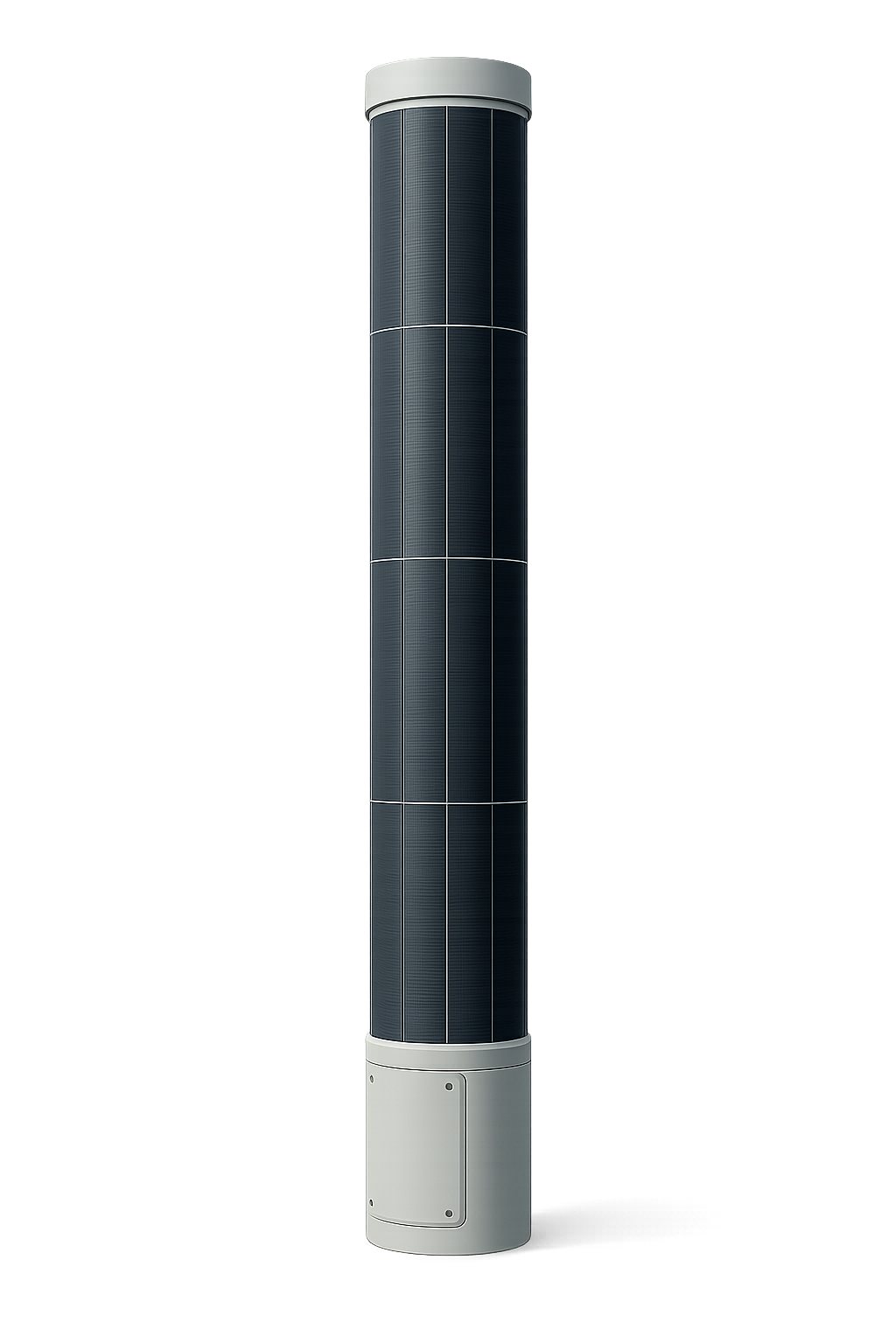
Sol-Pole is Lumiton Solar's residential concept for bringing vertical solar generation directly to homes, even when a rooftop is not a practical option. Instead of requiring roof access, structural reinforcement or scaffolding, a Sol-Pole style installation stands upright near the home, in a garden, along a boundary or beside a driveway, generating power close to where it will be used.
Sol-Pole: Sustainable Solar Infrastructure Designed to Evolve
A modular vertical solar system designed for fast deployment, low maintenance, component-level upgrades, and a more circular approach to solar infrastructure.
Solar power is inherently renewable. But the way solar systems are designed, installed, maintained, upgraded, and eventually decommissioned also matters.
A conventional photovoltaic system is often treated as a largely fixed installation. Modules, mounting structures, electrical equipment, cabling, communications hardware, and optional batteries are assembled into a system expected to remain in place for decades. When technologies change—or individual components reach the end of their useful life—upgrading the installation can become complicated.
At Lumiton Solar, we wanted to approach the problem differently.
Sol-Pole is designed as a compact, modular vertical solar system that can evolve over time rather than being treated as a product that must eventually be replaced as a whole.
The philosophy is simple:
Replace or upgrade the part that needs changing—not necessarily the entire system.
That design principle influences everything from installation and maintenance to future upgrades, recycling, storage, connectivity, and the system's long-term environmental footprint.
From Renewable Energy to Sustainable Product Design
Generating renewable electricity is only one part of sustainability.
A genuinely sustainable energy system should also consider:
how much material it requires;
how easily it can be installed;
how long its components remain useful;
whether parts can be repaired or upgraded;
how much maintenance it requires;
whether valuable materials can eventually be recovered;
and whether the infrastructure can adapt as technology changes.
These questions are becoming increasingly important as global solar deployment accelerates.
The International Energy Agency's PV Power Systems Programme increasingly emphasizes repair, refurbishment, reuse, component accessibility, replaceability, and design for recycling as important elements of a more circular photovoltaic industry.
Sol-Pole was developed around many of these same principles.
1. Modular by Design
At the center of the Sol-Pole concept is modularity.
Instead of thinking about a solar installation as one indivisible object, the system is designed as a collection of functional components.
Depending on configuration, these can include:
photovoltaic elements;
structural sections;
power electronics;
communications equipment;
control systems;
energy storage;
electrical interfaces;
monitoring hardware.
This creates an important distinction.
Conventional replacement approach
Component becomes obsolete or damaged → major system intervention or replacement
Modular approach
Component becomes obsolete or damaged → service, replace, recycle, or upgrade that component
The rest of the installation can continue serving its purpose.
This is particularly important for infrastructure expected to remain operational for many years because different technologies evolve at very different speeds.
The structural portion of a system may remain useful for decades, while communications hardware, batteries, sensors, controllers, or power electronics may advance considerably during the same period.
A modular architecture allows those technologies to evolve without automatically making the entire installation obsolete.
2. Up-Cyclable Instead of Disposable
We use the term up-cyclable to describe one of the most important ideas behind Sol-Pole.
When an individual component becomes degraded, outdated, or damaged, the objective is to replace or upgrade that component while continuing to use the rest of the system.
That means maintenance can potentially become an opportunity for improvement.
For example:
Original component → newer-generation component → system continues operating
rather than:
Original system → ageing component → entire system discarded
This philosophy becomes increasingly valuable as photovoltaic infrastructure expands globally.
IRENA and IEA-PVPS have long highlighted the growing importance of managing photovoltaic materials at the end of their useful life. Their research identifies reuse, repair, refurbishment, material recovery, and recycling as essential parts of a circular solar economy.
More recent IEA-PVPS research also specifically identifies design-for-repairability and component replaceability as important enablers of second-life photovoltaic systems.
Why modular replacement matters
Imagine that a communications module becomes outdated after several years.
There may be no reason to replace the solar structure.
If an electrical controller develops a fault, there may be no reason to discard functional mechanical components.
If better battery technology becomes available, the energy-storage subsystem should ideally be capable of evolving independently.
This is the principle behind Sol-Pole:
preserve what still works and improve what no longer meets the requirement.
3. Designed to Reduce Long-Term Waste
Solar modules are recyclable, but recycling should not always be the first step.
The hierarchy should ideally look more like:
Maintain → Repair → Upgrade → Reuse → Recycle
Extending useful life preserves the energy and materials already embodied in a product.
IEA-PVPS notes that extending the lifetime of photovoltaic equipment can be environmentally preferable to immediately sending usable equipment for recycling. Existing recycling facilities can recover significant portions of PV-module materials, while research continues to improve both recovery rates and recovered-material quality.
Sol-Pole's modular philosophy therefore addresses the waste problem at an earlier stage.
Instead of asking only:
"How can this system eventually be recycled?"
we also ask:
"How can we avoid replacing functional parts in the first place?"
That difference is fundamental.
Recycling remains important, but extending service life can reduce how frequently equipment enters the waste stream.
4. Fast Installation
Renewable-energy projects do not create value while they are sitting in boxes.
They create value when they are operating.
For that reason, Sol-Pole has been designed around simplified, modular deployment and a compact physical footprint. Lumiton describes the system as intended for fast installation across a wide range of locations, including applications where conventional solar installations may require greater available surface area or more extensive site preparation.
A compact vertical architecture can be particularly interesting where usable horizontal space is constrained.
Potential applications include:
residential properties;
commercial and industrial sites;
agricultural land;
infrastructure corridors;
remote locations;
communities with limited electrical infrastructure;
distributed energy installations;
locations where conventional solar arrays are impractical.
Instead of viewing solar exclusively as something that must occupy a large roof or field, vertical solar creates another design dimension.
Energy infrastructure can begin using space that otherwise performs little productive function.
Property edges, pathways, infrastructure boundaries, agricultural areas, and other narrow spaces may become potential generation locations.
5. A Compact Footprint Opens New Locations
Traditional tilted solar arrays need unobstructed horizontal area.
That is perfectly suitable for many installations—but not every site has that luxury.
Cities have competing land uses.
Factories need working areas.
Agricultural land needs to remain productive.
Remote locations may have difficult terrain.
Residential properties may have unsuitable roofs.
Vertical solar creates another option.
Because Sol-Pole concentrates generating surfaces vertically, the system is designed to bring solar generation into locations where footprint matters.
This does not mean vertical systems replace conventional PV everywhere.
Rather, they expand the number of places where photovoltaic generation can be considered.
That can become particularly important as electricity generation moves toward a more distributed model in which energy is increasingly produced closer to where it is consumed.
6. Designed for Low Maintenance
Every energy system requires some level of inspection and maintenance.
The goal should therefore not be to pretend maintenance disappears, but to design equipment so routine servicing is straightforward and unnecessary intervention is minimized.
Sol-Pole's modular architecture is intended to support that objective.
Accessible and replaceable components can make it easier to isolate a problem without unnecessarily disturbing functional parts of the installation.
Vertical orientation can also offer practical environmental advantages in some climates.
Compared with low-angle surfaces, vertical photovoltaic surfaces can be less prone to accumulation of certain types of debris and may retain less snow under appropriate conditions.
The actual maintenance requirement will always depend on local factors such as:
dust;
precipitation;
vegetation;
snow;
pollution;
nearby roads;
installation environment;
component selection.
The important point is that maintainability is treated as a design requirement rather than an afterthought.
7. Ready for Storage
Solar generation becomes considerably more flexible when combined with energy storage.
Sol-Pole is designed with integrated battery options, allowing a system to potentially generate electricity when sunlight is available and preserve some of that energy for later use.
This can be useful where the objective extends beyond simply exporting instantaneous solar production.
For example:
Day
Solar generation → loads + battery charging
Evening
Battery → local loads
Grid interruption
Stored energy → selected critical loads, depending on system configuration
Storage can be especially valuable for distributed installations and locations where grid reliability is limited.
Rather than viewing the solar module, battery, and control system as independent technologies, Sol-Pole is intended to provide a platform where they can operate together.
8. Connectivity Turns a Solar System Into Smart Infrastructure
The future electrical grid is not simply a network of generators.
It is increasingly a network of connected energy assets.
Sol-Pole can be configured with connectivity and smart-grid functionality, creating possibilities beyond basic electricity generation.
Depending on the final application and configuration, connected infrastructure can support functions such as:
remote monitoring;
system-status reporting;
performance analysis;
energy-management controls;
fault identification;
communications;
distributed asset management.
This is especially relevant when installations are deployed across multiple locations.
Instead of manually inspecting every site to understand whether it is operating normally, connected infrastructure can provide information remotely.
For rural and remote installations, connectivity itself may also become part of the infrastructure service Lumiton is seeking to enable.
9. Upgrade the Intelligence Without Rebuilding the Infrastructure
One of the largest advantages of modularity may appear years after installation.
Digital technology evolves quickly.
A solar structure installed today may remain mechanically functional many years from now, while its communication technology could become outdated several times during the same period.
A modular platform creates the possibility of upgrading the intelligence of the system independently.
For example:
Generation hardware
↓
Power electronics
↓
Battery
↓
Controller
↓
Connectivity
↓
Energy-management software
Each layer can evolve at a different rate.
The long-term objective is infrastructure that becomes better through upgrades rather than obsolete through ageing.
10. Better Suited to Distributed Energy
Large solar farms will remain an essential part of the global energy transition.
But not every energy problem requires a large power plant.
Sometimes electricity is needed:
beside a home;
next to a business;
on a farm;
near telecommunications equipment;
at an isolated facility;
along existing infrastructure;
or in a community far from dependable grid connections.
This is where compact distributed systems can become particularly valuable.
Lumiton developed Sol-Pole with adaptability—including deployment in remote locations—as an important design objective.
A modular system combining generation, optional storage, and connectivity can effectively become a small piece of local energy infrastructure.
And multiple systems can be deployed where greater capacity is required.
11. Sustainability Beyond the Solar Cell
When people evaluate solar systems, the first question is usually:
How much electricity will it produce?
That remains essential.
But as renewable-energy deployment grows, additional questions become increasingly important:
How much land does it require?
How difficult is it to install?
How easily can it be maintained?
What happens when one component fails?
Can new technologies be integrated later?
Can usable components remain in service?
Can materials eventually be recycled?
These questions move the conversation from renewable electricity toward sustainable infrastructure.
That distinction is central to Sol-Pole.
A Solar System That Can Evolve With Its Environment
The energy transition will last much longer than the technology cycle of today's electronics.
Batteries will improve.
Power electronics will improve.
Communication protocols will change.
Energy-management software will become more intelligent.
Grid requirements will evolve.
Materials and photovoltaic technology will continue advancing.
Infrastructure designed today should therefore not assume that every component installed today will remain the optimal component tomorrow.
That is why modularity matters.
Sol-Pole is designed around a straightforward idea:
Keep the infrastructure that continues to provide value.
Upgrade the components that can be improved.
Replace the components that eventually fail.
Recycle materials when they truly reach the end of their useful life.
The result is a different way of thinking about solar.
Not simply as a panel.
Not simply as a power generator.
But as adaptable energy infrastructure designed to evolve.
The Core Benefits of Sol-Pole
Up-Cyclable
Individual components are designed to be replaceable or upgradeable without automatically replacing the entire installation.
Modular
A modular architecture allows different parts of the system to evolve independently.
Fast to Deploy
The compact system is designed around simplified installation and deployment across diverse locations.
Low Maintenance by Design
Accessible components and vertical architecture are intended to simplify long-term operation and servicing.
Space Efficient
Vertical generation opens possibilities where large horizontal PV arrays may be impractical.
Battery Ready
Integrated storage options can extend the usefulness of generated solar energy beyond daylight production.
Connected
Connectivity options enable monitoring, communications, and future smart-energy applications.
Adaptable
The platform can serve residential, commercial, agricultural, remote, infrastructure, and distributed-energy applications.
Designed for Circularity
Repairability, component replacement, reuse, upgrading, and eventual recycling can help move solar infrastructure toward a more circular lifecycle.
Building Renewable Energy That Lasts
The next stage of solar innovation is not only about producing more watts.
It is also about building systems that use land intelligently, remain serviceable, adapt to new technology, and preserve useful materials for as long as possible.
That is the idea behind Lumiton Sol-Pole.
Generate today. Upgrade tomorrow. Keep the infrastructure working for the future.
Further reading
Lumiton describes Sol-Pole as a compact vertical solar platform designed for fast installation, low maintenance, modular upgrades, storage, connectivity, and applications ranging from homes to remote and utility-scale installations.
IEA-PVPS research on circular photovoltaics highlights repairability, lifetime extension, component accessibility, reuse, recycling, and design for circularity as increasingly important considerations for future photovoltaic systems.