Vertical Solar vs Traditional Solar Farms
Lumiton Solar sees vertical solar as an expansion of traditional solar possibilities. Traditional solar farms will remain essential, but vertical systems can add new formats for clean electricity generation. The future of solar will not be one layout only. It will include multiple designs matched to different sites.
Lumiton Solar
7/22/20263 min read
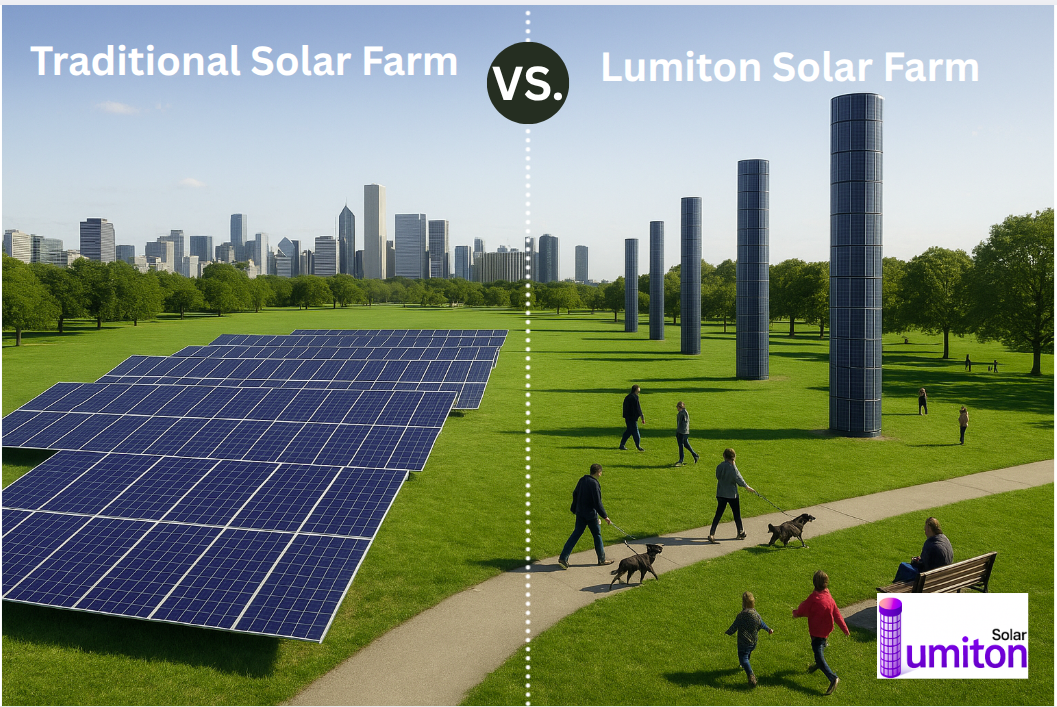
Traditional solar farms require large horizontal space, but Lumiton Solar will use vertical space to generate clean energy closer to homes, roads, facilities, and public infrastructure.
Which One You Choose?
Traditional solar farms have helped make solar electricity one of the fastest-growing energy technologies in the world. They usually use rows of tilted panels installed across large open areas. This format can be efficient, proven and scalable. But it also depends on land availability, grid connection, site preparation and long-term maintenance access.
Vertical solar farms use a different approach. Panels are mounted upright, often in rows or modular structures. In bifacial designs, both sides of the module can collect light. The result is not simply a visual change. It can change the way a project uses land, how it interacts with other activities and when it generates electricity during the day.
Land use and site flexibility
Ground-mounted solar farms require enough horizontal area for panel rows, spacing, access paths, electrical equipment and safety buffers. For many projects, this is manageable. For others, it creates conflict with agriculture, housing, biodiversity, infrastructure or local planning rules.
Vertical solar can reduce the pressure on horizontal land because the system uses height and narrower footprints. This may allow solar generation along boundaries, corridors, field edges, transport infrastructure, fences or other spaces that would not support a conventional solar farm.
Energy production profile
Traditional tilted systems often focus on strong midday production. Vertical east-west bifacial systems can produce a different curve, with more generation in the morning and evening depending on location, orientation and module design. This can be useful in electricity systems where the midday solar peak is already high or where demand occurs outside the middle of the day.
This does not mean vertical solar is always higher-yielding. It means the generation profile can be different. The right comparison should consider annual output, timing of output, electricity value, site constraints, maintenance and land use.
Agrivoltaics and dual land use
Vertical solar is especially interesting for dual-use sites. In agriculture, vertical rows can leave more ground open for machinery movement, grazing, crops, drainage and maintenance. They may also reduce the amount of land physically covered by panels compared with dense tilted arrays.
For non-agricultural sites, dual use can mean combining solar with fences, barriers, security lines, roadside infrastructure or visual screening. This makes vertical solar valuable where the structure can serve more than one purpose.
Installation and infrastructure
Traditional solar farms usually require detailed civil works, racking, roads, cable trenches, inverters, transformers and grid connection studies. Vertical solar projects can also require strong engineering, especially for wind loads and structural safety. The difference is that vertical systems can be modular and placed in smaller or more distributed zones.
For a utility-scale project, vertical solar may not replace every conventional solar farm. It may become part of a more diverse solar strategy, adding generation in locations that conventional arrays cannot use efficiently.
Maintenance considerations
Maintenance access is a major factor in every solar project. Vertical panels may be easier to inspect from the ground, depending on height and structure. Upright installation can also reduce some forms of dirt accumulation, though site-specific conditions still matter.
Engineers must still consider wind, vibration, anchoring, corrosion, cable routing and safety zones. A vertical solar farm is only as good as its structural and electrical design.
When traditional solar farms are better
Traditional ground-mounted farms remain a strong option when land is available, grid connection is practical, terrain is suitable and project economics favour a proven layout. They are supported by extensive industry experience and supply chains.
When vertical solar is better
Vertical solar becomes more attractive where land is constrained, dual use matters, visual footprint matters, morning or evening generation has value, or solar must be placed along boundaries and corridors. It also has potential where modular deployment is more important than building one large contiguous solar field.
Lumiton Solar’s perspective
Lumiton Solar sees vertical solar as an expansion of solar possibilities. Traditional solar farms will remain essential, but vertical systems can add new formats for clean electricity generation. The future of solar will not be one layout only. It will include multiple designs matched to different sites.
FAQ
Are vertical solar farms more efficient?
Efficiency depends on the definition. A vertical layout may be more space-conscious or better matched to specific demand timing, but total energy output depends on site design and solar conditions.
Can vertical solar be used on farms?
Yes. Vertical bifacial rows are being studied and deployed for agrivoltaic and dual-land-use applications.
Does vertical solar need bifacial panels?
Not always, but bifacial modules are often useful because both sides of a vertical panel can receive direct, diffuse or reflected light.