Solar Towers: Clean Power with Small Footprints
Solar towers are designed for situations where clean power is needed but wide land or roof space is limited.
8/20/20265 min read
With integrated options for batteries, connectivity, and smart grid.


Sustainable By Design
"Small parts need to be replaced (upgraded), not entire system. Broken parts can be recycled." Lumiton Solar
Fast Installation
Low Maintenance
A modular compact system that can be up-cycled not be replaced.
Up-Cyclable




Learn about Vertical Solar Towers:
Why small-footprint solar matters
What a solar tower can do
How solar towers differ from rooftop solar
Ideal applications for solar towers
The role of storage and connectivity
Design questions before choosing a tower
Frequently asked questions
Sources and further reading
Solar towers is becoming more relevant as homes, businesses, communities and infrastructure owners look for clean energy solutions that fit real-world space constraints.
Why small-footprint solar matters
Solar energy is often associated with rooftops and large fields. These formats are important, but they are not always available. A site may be too small, shaded, remote, temporary, regulated or crowded with other equipment. In these cases, a compact vertical system can be more practical than a wide horizontal array.
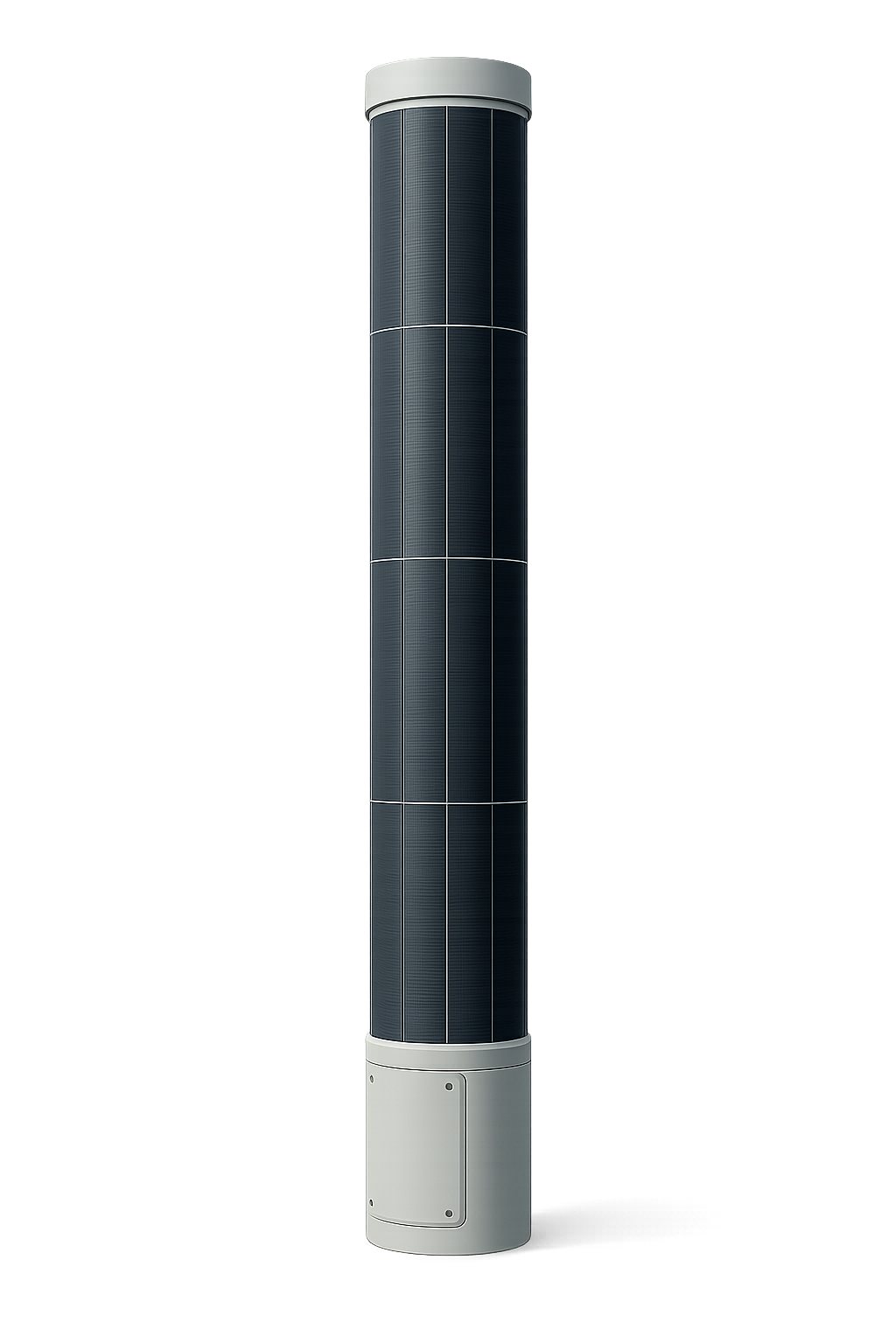
A solar tower is a vertical solar structure designed to produce electricity from a smaller ground footprint. Instead of spreading panels across a roof or field, it arranges solar surfaces upward. This can make solar possible in places where land is scarce or where the project cannot dedicate a large area to power generation.
Lumiton Solar’s vertical solar approach includes tower-style concepts for homes, facilities, remote communities, public sites and utility-scale projects. The goal is not to replace every solar farm. It is to expand where solar can be installed.
What a solar tower can do
A solar tower can support distributed clean power. Depending on size and configuration, it may help supply lighting, communication equipment, monitoring systems, pumps, charging points, buildings or selected loads. When paired with batteries, it can also store energy for later use.
For remote sites, a solar tower can reduce dependence on fuel deliveries or weak grid connections. For commercial sites, it can add visible renewable generation without occupying important operating areas. For public spaces, it can combine clean energy with education, identity and infrastructure services.
The best use cases are those where the tower’s small footprint creates a real advantage. If a site already has a huge empty field, a standard ground-mounted system may be simpler. If the site is constrained, vertical design becomes more valuable.
How solar towers differ from rooftop solar
Rooftop solar depends on the roof. The roof must have enough area, structural strength, orientation, access and lifetime. A solar tower depends more on a chosen ground location and a purpose-built structure. This can be helpful when roofs are unsuitable or already full.
A tower may also be easier to inspect than a rooftop array because major components can be accessed from ground level or planned maintenance points. However, it must be engineered carefully for wind, foundations, lightning protection and local safety rules.
Rooftop solar is often invisible from the ground. A solar tower is visible. That can be an advantage for organizations that want to show leadership in clean energy, but it also means aesthetics and placement matter.
Ideal applications for solar towers
Solar towers can be relevant for remote communities, temporary sites, rural facilities, farms, telecommunications, border areas, parks, industrial yards, school campuses, emergency infrastructure and off-grid energy projects. They are also interesting for demonstration projects because they make solar technology easy to see and understand.
In a residential context, a tower may be considered where the property has limited roof area but enough outdoor space for a safe installation. In a commercial context, it can be placed near parking, entrances, equipment zones or internal roads. For remote infrastructure, it may power a defined load with storage and monitoring.
A solar tower should be matched to the load. The design process should begin with the question: what exactly needs electricity, how much energy does it need, and when does it need it?
The role of storage and connectivity
A tower can produce electricity during daylight hours, but many useful loads require energy at night or during cloudy periods. Battery storage can improve the value of the system by shifting energy to the time it is needed. Monitoring can show whether the system is performing as expected.
Connectivity is especially important for remote towers. If a site is far from regular maintenance teams, operators need visibility into battery status, generation, faults and load behavior. A connected solar tower can become part of a managed energy network instead of an isolated piece of equipment.
This is why Lumiton Solar’s vertical systems are best understood as more than panels. They can combine solar generation, storage and smart monitoring in a compact structure.
Design questions before choosing a tower
Before choosing a solar tower, review site sunlight, wind exposure, soil or foundation needs, expected load, battery requirements, local permits, visual impact, access and security. A tall structure may need more engineering than a low ground-mounted array, but it can also deliver value where horizontal space is unavailable.
The location should avoid unnecessary shading and allow safe installation. It should also be close enough to the electrical load or connection point to avoid excessive cabling costs.
A well-designed solar tower is not just a symbol. It is a functional energy asset for space-limited sites.
Key takeaways
Vertical solar can unlock boundaries, corridors and space-limited locations that may not suit conventional solar layouts.
The best design depends on sunlight, shading, load profile, safety, storage needs and site access.
Battery storage and monitoring can increase reliability, especially for remote or off-grid applications.
For strong SEO and user value, publish the post with a clear title, unique excerpt, internal links and accurate source references.
Frequently asked questions
What is a solar tower?
A solar tower is a vertical or tower-style structure that supports photovoltaic modules to generate electricity from a compact footprint.
Where are solar towers useful?
They are useful in remote, space-limited or infrastructure-heavy locations where a wide solar array is difficult to install.
Can solar towers include batteries?
Yes. Battery storage can help supply power when sunlight is not available and can improve reliability for selected loads.
Explore Lumiton Solar
Lumiton Solar develops Swiss-designed vertical solar systems for residential, commercial, remote and utility-scale energy applications. If you are evaluating a site, start with the project goal, available space and energy demand.